 About
Us
About
Us
        |
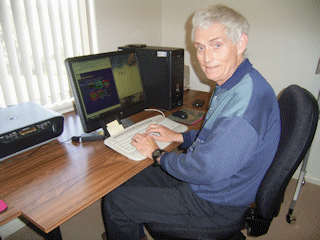
Over the years I've worked with many different mainframe computers and later in life, just prior to my retirement in 1999, with client-server equipment and the Internet. My last project was helping to develop the first system in WA to provide Geodetic survey information via a website. I've programmed in Fortran IV, COBOL, various assemblers, Pascal, C, C++, BASIC, Visual BASIC, Delphi, and have dabbled with many other programming languages. The development system I am currently using is Borland Delphi whose underlying programming language is Object Pascal - an object-oriented version of Pascal. My first home computer was an Apple II Europlus which was an amazing machine for its time. I bought mine in 1982. It had a 1 MHz CPU, 48KB RAM and 128KB 5.25" floppy disks. I optioned mine up to 64KB RAM with a 16KB expansion card and also installed an 80-column upper/lower case card because the raw machine could only display 40 characters per line all in upper case. When you switched it on, it immediately booted up into Applesoft BASIC which was a flavour of Microsoft BASIC and this is where I did a lot of my BASIC programming. It also had a beaut little assembly language called 6502 assembler. It had exactly 56 different machine instructions and so it was fairly easy to get your mind around. The Apple II came with what was called a mini-assembler but it was rather crude and difficult to use for anything but a small subroutine. So the first thing I did was to write a proper 6502 assembler rather than buy one - much more fun! The assembler started out as a BASIC program which, when you ran it to assemble some code and you also wanted a printout of the assembler code and a variable map it took about 4 hours to run! So I wrote assembler code for the assembler and assembled it with my BASIC assembler until I got it to such a stage that the assembler had enough functionality to run on its own. I then used the assembler to assemble itself and this ran and printed out a program listing and a variable map in about 15 minutes - a vast improvement on 4 hours! Once I'd developed the 6502 assembler to a fairly advanced stage, I then wrote a text editor completely in assembler, so now I could enter my assembler code and then assemble the code into an executable program using only my editor/assembler system. I managed to sell several copies of this. Then I purchased Apple Pascal which was a complete program development system using Pascal as its programming language. I wrote many games and utility programs using this system. Then in 1986 I saw a demonstration of the Commodore Amiga and its graphic capabilities blew me away! I just had to have one! This was a 7MHz machine with a separate graphics co-processor. So I sold my Apple II and bought an Amiga. The native programming language on the Amiga was C and so I had to learn another language. I wrote a much more advanced text editor which I publlished in cooperation with my programmer friend Stephen Strong and sold several hundred copies. Then eventually, because we used IBM PC compatibles at work, I switched to a PC compatible at home too. This way I could develop routines at home and use them in my programs at work. We started out by using the OS/2 operating system but eventually switched over to Windows NT at work and Windows 3.1 at home. I've always been writing computer games even before I had my own computer at home. I find that writing a game is a good way to learn a new programming language. It uses all the different aspects of the computer, input from keyboard and mouse, graphics output via the screen and printer, file output to disk, and computational routines to make the game function. Being a game, it's fun to test it as development progresses, and it keeps your interest because you can't wait to program the next little bit and try it out. So I used to write games, not so much for myself but for my children, Peter and Ruth. I find that once I've developed a game and rigorously tested it, I get bored with it and want to get on to the next project. Then Peter and Ruth got married and grandchildren came along and I was writing games for them too. Soon I had quite a collection of games. After I took early retirement in July 1999, Joy and I moved from Perth to Albany on the south coast of Western Australia and it wasn't until 2002 that I thought it would be nice if I could share my games with more than just my close relatives. It was then that I got the idea of creating a website and offering my games to the world! And so Spoonbill Software was born. I decided to offer my games as Freeware because I didn't want all the hassles of managing credit card transactions and all the tax implications which that would have created - I was retired from the rat race and wanted a peaceful life! Because Freeware doesn't generate an income, I didn't want my website to cost me money and so I can only use the 10MB of free space which is provided as part of my ISP subscription. This being the case, I didn't have enough space to store all my programs on the ISP server for direct downloading. It was then I hit on the idea of disseminating my games via e-mail. It also turns out that this system is more personal and I get to chat with many of my clients. Some people request games, I send them and I hear no more. Others are more friendly and thank me for the games, let me know how much they enjoy them and even offer suggestions for future improvements. Some even tell me a little about their country. The personal touch takes away that coldness of knowing you're talking to a computer at the other end of the line. The Internet's a wonderful thing. I have sent my games to people all over the world and when I get words of appreciation and encouragement, it makes all the hundreds of hours I've spend writing the games seem worthwhile. In July 2010 I ceased attaching games setup files to e-mails because there are too many inherent problems. It was late in June 2010 that I discovered Dropbox. It was just what I needed. So I uploaded the setup files for all of my games onto Dropbox which provides the free space which my ISP doesn't provide. So now when you order a game, I just e-mail you the download link and you can download it at your leisure. In 2004 I started writing computer games for blind people. This has proved a very rewarding exercise. And thus was born my Blind Gamers series of games. Demand for my accessible games has far outstripped the demand for my sighted games, except for Apple Lode Runner - The Remake which has gathered the largest following around the world. Thanks to the Internet, I have now sent my games to more than 100 countries world wide. As from 7th November 2007, Spoonbill Software's website address is: http://www.spoonbillsoftware.com.au |