|
|
![]() ![]() ![]() ![]() ![]() ![]() ![]() ![]() ![]() ![]() ![]() ![]()
|
Requires SAPI Text-To-Speech and DirectX
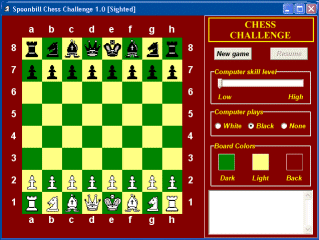
Released September 2008 (2.5 MB) Spoonbill Chess Challenge was originally written as an accessible game of chess for blind and vision impaired players. It is designed to play a good game of Chess against an average player. It is not designed to be world beating and has not been rated against any other chess engine. It can be run in one of three modes: Blind, Vision Impaired or Sighted. Run in Sighted mode it can be operated using the mouse. Its features include:
Why not accept the challenge and order your copy today? As with all Spoonbill Software's offerings, it is absolutely free!
Released February 2008 (1.5 MB) New features added in the 2.0 upgrade include:
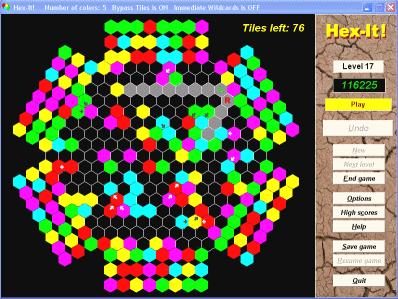
If you liked Brick Shooter then you'll LOVE Hex-It! Hex-It! takes brick shooting to another level. The object is to clear the board of fixed tiles and advance to the next level. You score points for groups of tiles of the same color which are then removed from the board. The larger the number of tiles in a group, the more points you score. Scores are also multiplied by the level number to encourage you to advance to the next level as quickly as possible. On each new level there are more and more fixed tiles to clear, so although you score many more points per group on higher levels, these levels are also more difficult to clear. The ultimate aim of the game is to reach the highest level possible with the highest score, before the game ends when no more productive moves are possible. You get bonus points if you can set up a volley of shots, each of which removes a group of tiles. You also get bonus points if you can create a cascade effect, where a removed group of tiles frees up other tiles which move to form further groups of tiles which are then automatically removed. The board is hexagonal and each edge is bordered by a pool of hexagonal tiles arranged in three rows of eight tiles. Only the inner row of tiles is playable. The other two rows of tiles are previews of tiles yet to become playable. Tiles can be launched onto the board in one of two directions, you do this by either clicking the left or the right mouse button. Tiles launched onto the board from a tile pool are mobile as opposed to fixed and this is indicated by an arrow pointing in the direction of movement. Played tiles will travel across the board until they are obstructed by another tile. When the obstruction is removed, they continue to move in their initial direction until either they butt up against another tile or they reach the other side of the board where they push their way into the tile pool. Features of this game include:
So what are you waiting for? Why not accept the challenge and order your copy today? As with all Spoonbill Software's offerings, it is absolutely free! Spoonbill Penta 1.0 Requires DirectX Released April 2006 (820 KB)
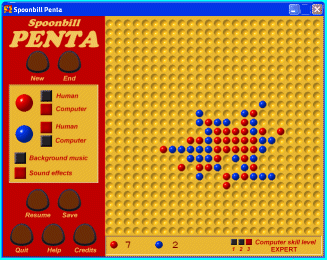
The object of the game is to score 10 points before your opponent does. Players take it in turns to play a stone to the board. When a player succeeds in making a line of five or more stones either horizontally, vertically or diagonally, he or she scores one point. The game is a series of plots and counter plots. Decisions must be made as to whether to play an attacking move, threatening to complete a line of five yourself, or to play a defensive move to prevent your opponent from scoring a line of five. Each player is trying to outwit the other by setting traps which cannot all be blocked with a single move, while at the same time trying to thwart the attempts of the opponent to set up traps of his own. Spoonbill Penta features the following:
This is a game which is simple in concept, yet complex in practice. Take the challenge today, order your copy of Spoonbill Penta today! As with all Spoonbill Software's offerings, it is absolutely free! Triad 1.0 Requires DirectX Released November 2005 (1 MB)
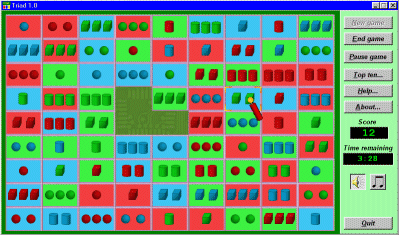
Triad is a game of matching attributes. At the beginning of the game, the playing board
displays 81 tiles in a 9 x 9 array. LAP - The Deduce the Color Scheme Game - Version 1.0 Released August 2005 (572 KB)
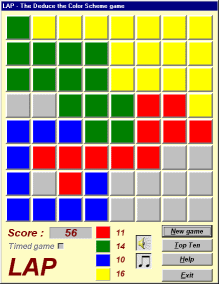
LAP is a game of logic where you have to deduce the hidden color scheme. Hints cost 1 point each and each bad guess costs you 5 points. You try to guess the color of all 64 tiles whilst accumulating as few penalty points as possible. You know that there are always 16 tiles of each of 4 colors and that all the tiles of each color form a contiguous area. Using this knowledge and some intelligently placed hints, you gradually reveal the hidden colors. You can play the game in either Untimed or Timed mode. Untimed mode gives you as long as you want to make each guess. In timed mode you are not only accumulating penalty points for hints and bad guesses, but also 1 penalty point per second of elapsed time!
Released September 2007
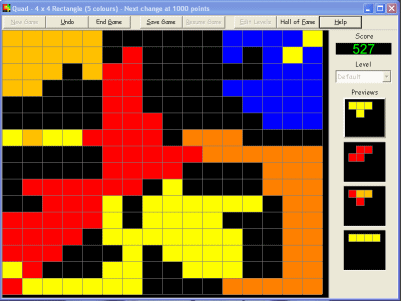
Version 1.1 includes a Save and Resume feature. Quad is a topological game of skill. In a way it is like Tetris but without the pressure of a time limit. The object of the game is to get as many points as possible. To do this you must keep the board as clear as possible. When there is no more room to play a piece, the game is over. The only way to clear the board of played pieces is by making a rectangle of the specified size made up of cells of a single color. We'll refer to this as a Quad.When you make a Quad, all the cells of the Quad will be removed, together with all the cells of the same color which form a contiguous area with the Quad. Each play consists of playing the piece in the top preview panel onto the board. You can rotate the piece in any one of four ways. You try to play each piece so that you build up areas of the same color. A glance at the next four pieces will help you decide where to play the current piece. Beware of the "rogue" multi-color pieces! SCAN Solitaire (810 KB) Requires DirectX
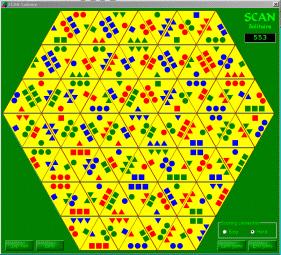
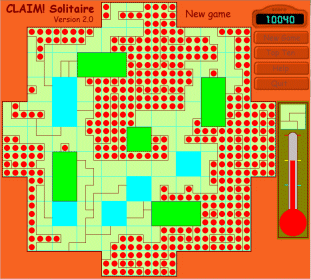
SCAN Solitaire is a derivative of the original SCAN (Shape, Color And Number) game for two players. Position the triangular tiles on the board matching as many attributes along an edge as possible. Match attributes along two or all three edges in one play to boost your score even further. The tile in the middle is the starter tile, you play the other 72 tiles which are all different. When you have completely filled the board with tiles, if your score is good enough, it will be added to the Top Ten. CLAIM! Solitaire (800 KB) Requires DirectX CLAIM Solitaire is played on a special board with a random selection of playing pieces or tiles, chosen from a pool of 76 different ones. The tile pool is the same as for the normal game of CLAIM (75 tiles) plus an extra blank tile. Each tile contains 9 square units of area (3 by 3), divided in various ways by heavy lines which represent boundary fences. As each random tile is displayed in the preview area, you play it onto the board, placing the tiles such that you can enclose as much territory as possible. The larger the territory you claim, the more points you score. For example, for a territory with an area of 2 square units, you score 3 points, whilst for a territory with an area of 15 square units, you score 120 points and for a territory with an area of 30 square units, you score 465 points. Fences at the edges of the board and fences around islands within the playing area count as boundaries for the purposes of enclosing a territory, but you cannot claim the green islands as territory. Balls (675 KB)
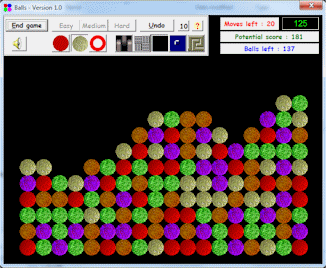
Balls is a game of logic. At the start of the game you are presented with a random layout of colored balls which react to gravity when balls beneath them are removed. In other words, a ball can fall vertically if the ball beneath it is removed, or it can roll sideways if supporting balls at either side of it are removed. Balls cannot roll horizontally, only downhill. The object of the game is to score as many points as possible by removing balls from the layout. The larger the number of contiguous balls in a group, the more points you score for removing that group. When you have removed as many groups of balls as possible, and the number of moves left becomes zero, this is the end of the game, and your score, if it is good enough, will be added to the Top Ten Scores. If you can remove all but the last few balls, instead of being the end of the game, you will get a bonus game to allow you to further increase your score. Send your request to Ian Humphreys (together with your full name and country) at: games@spoonbillsoftware.com.au e.g. My name is Joe Blow from Utah, USA, please send the following games... IMPORTANT: Please allow up to four days for delivery. NOTE: We cannot send games to a Google gmail address. If you have a gmail address, please supply an alternate address for mailing your games. A free yahoo address from www.yahoo.com is quite acceptable. ALSO: Corporate email addresses are usually not suitable, their virus filters often do not allow attachments containing .EXE or .ZIP files. Please try to supply your personal email address to avoid delays with delivery of your games. Please feel free to tell us what you think of our products. We always welcome constructive comments and any suggestions for future new games or other applications. And when you talk to Spoonbill Software you are talking to a REAL person, not a computer program. If you have any problems with installing the software sent to you please contact us via e-mail at the address below. |
|
Send mail to webmaster@spoonbillsoftware.com.au with
questions or comments about this web site.
|